Why Am I Nauseous After a Concussion?
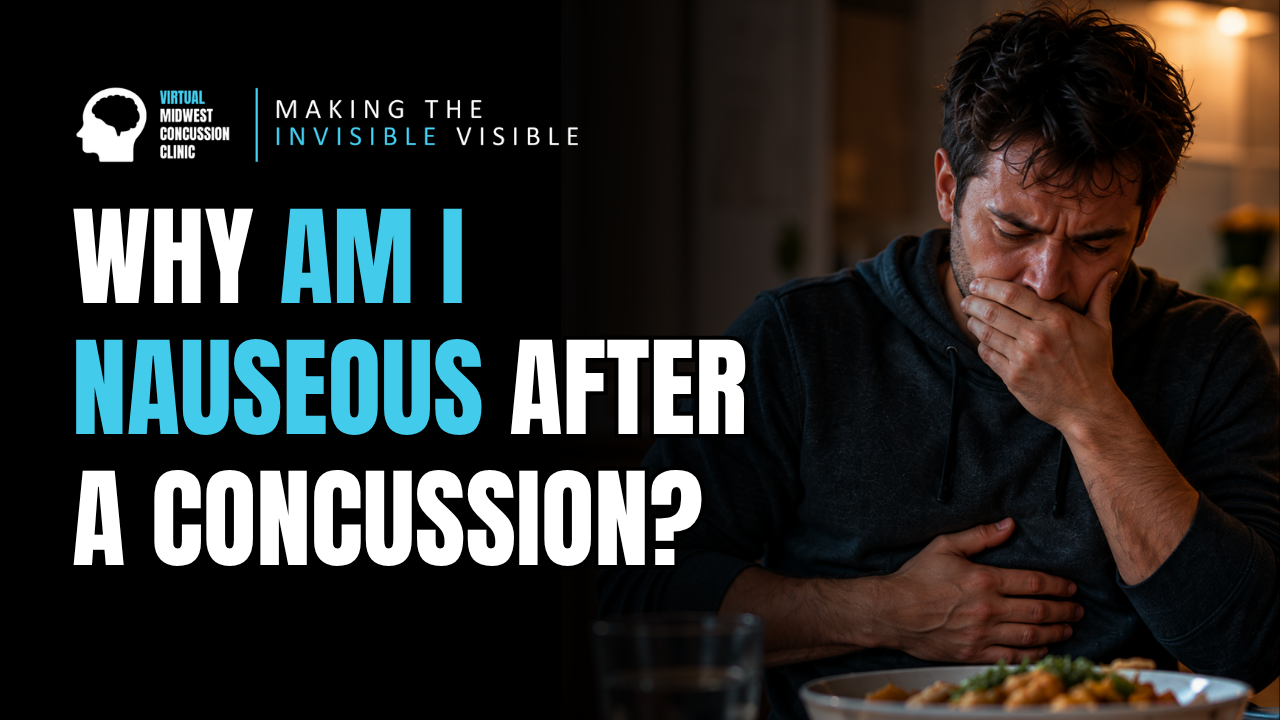
Understanding why nausea happens, what your symptoms may be telling you, and why identifying patterns matters.
Nausea after a concussion can be frustrating, unpredictable, and difficult to explain.
You might feel nauseous when you first wake up. Maybe it happens after eating, while riding in a car, scrolling through your phone, or simply trying to get through a busy day.
Sometimes there’s an obvious trigger. Other times, it feels like it comes out of nowhere.
So, why are you nauseous after a concussion?
The answer is that there isn’t just one reason.
Nausea after a concussion can be associated with changes in how your brain processes movement and visual information, how your body regulates certain functions, eating patterns, medications, and several other contributing factors.
And sometimes, more than one of those things is happening at the same time.
That’s why understanding nausea requires more than simply recognizing that you’re nauseous.
We need to understand why it’s happening to you.
Nausea Is a Symptom. Not an Explanation.
One of the most important things I try to help people understand during concussion recovery is the difference between identifying a symptom and understanding what’s contributing to it.
When someone tells me they’re nauseous, that’s valuable information.
But it doesn’t tell me everything I need to know.
Consider four different people recovering from concussions.
One feels nauseous every morning.
Another becomes nauseous while riding in a car.
A third notices nausea shortly after eating.
And another feels fine until their heart rate increases during physical activity.
All four are experiencing nausea.
But would we automatically assume they’re experiencing it for the same reason?
Of course not.
Same symptom. Different potential contributors.
Recognizing that distinction changes how we approach the problem.
Instead of immediately asking, “How do we stop the nausea?” we need to begin with a different question:
“What’s contributing to the nausea in the first place?”
When Does Your Nausea Happen?
Sometimes the most useful information isn’t how severe your nausea feels.
It’s when it happens.
Timing can help us recognize patterns that might otherwise go unnoticed.
For example:
- First thing in the morning: Is nausea present immediately upon waking, or does it develop after getting out of bed?
- After eating: Does it happen with certain foods, larger meals, or after going a long time without eating?
- While using screens: Does scrolling, reading, or watching moving images make symptoms worse?
- During movement: Does nausea increase while walking, turning your head, or riding in a vehicle?
- Later in the day: Does it become more noticeable after several hours of activity, conversation, work, or other demands?
None of these patterns automatically identifies the cause.
But each gives us something worth investigating.
The goal isn’t to become hyper focused on every symptom or constantly search for something wrong.
It’s to recognize whether there are consistent relationships between what you’re doing and how you’re feeling.
The “when” can give us clues about the “why.”
Sometimes Nausea Isn’t a Stomach Problem. It’s an Input Problem.
One of the more commonly overlooked contributors to nausea after a concussion involves how your brain processes sensory information.
Your brain is constantly receiving information from different systems.
Your eyes provide visual information about your surroundings.
Your vestibular system, located in your inner ear, helps detect head movement and position.
Information from your muscles and joints also helps your brain understand where your body is in space.
Under typical circumstances, these systems work together to help you maintain balance, orient yourself, and move through your environment.
But after a concussion, processing and integrating this information may become more difficult.
Imagine sitting in the passenger seat of a moving car.
Your eyes are taking in rapidly changing scenery. Your vestibular system is detecting movement. Your brain is working to interpret that information together.
When those signals don’t agree, or your ability to process them is disrupted, symptoms such as dizziness, visual discomfort, and nausea may develop.
The same thing can happen when you’re scrolling through your phone, walking through a crowded store, or watching movement on a screen.
Your stomach might feel like the problem.
But the contributing issue may involve how your brain is interpreting the information it’s receiving.
INPUT → PROCESSING → CONFLICT → NAUSEA
This is why understanding visual and vestibular function can be an important part of a concussion evaluation.
What About Nausea After Eating?
When someone experiences nausea after a meal, it’s natural to assume something they ate must be responsible.
And sometimes, food does play a role.
But before we start eliminating foods or dramatically changing someone’s diet, I want to understand the relationship between eating and symptoms.
For example:
Did nausea begin before eating or afterward?
Does it happen after every meal or only certain meals?
Is it associated with a particular food or ingredient?
Does it happen when someone goes several hours without eating?
Are hydration or meal timing contributing factors?
These questions matter because what you eat and when you eat are two different things.
If nausea consistently occurs after going long periods without food, that may lead us in a different direction than nausea associated with a particular ingredient.
And if there isn’t an obvious relationship between eating and symptoms, we need to consider other possible contributors rather than automatically blaming food.
In some situations, dietary changes may be worth discussing with an appropriate healthcare professional, including the balance of nutrient-dense foods and overall eating habits.
But the first step should be understanding the pattern rather than unnecessarily restricting foods.
Food is information.
It shouldn’t become something you’re afraid of.
Other Factors That Can Contribute to Nausea After a Concussion
Visual and vestibular function and eating patterns are important considerations, but they’re not the entire picture.
Several other systems can influence how someone feels after a concussion.
Autonomic Nervous System Regulation
Your autonomic nervous system helps regulate functions such as heart rate, blood pressure, and digestion.
Changes in autonomic regulation can occur after concussion and may contribute to symptoms associated with standing, exertion, or changes in physical demand.
For someone who becomes nauseous when their heart rate increases, for example, it’s worth exploring how their body responds to activity rather than assuming the symptom is related to food.
Neck and Cervical Involvement
A concussion can occur alongside an injury or dysfunction involving the neck.
Cervical problems may contribute to dizziness, headaches, altered movement tolerance, and other symptoms that can overlap with concussion-related complaints.
The relationship between neck movement, dizziness, and nausea may provide useful information during an evaluation.
Medication Effects
Some medications can cause nausea or affect appetite, digestion, and dizziness.
If someone has recently started a medication, changed a dose, or begun taking something for concussion-related symptoms, that information deserves consideration.
Medication changes should always be discussed with the prescribing healthcare professional.
Gut-Brain Communication
Your brain and digestive system communicate through complex neurological and physiological pathways.
Changes involving stress responses, autonomic regulation, appetite, and digestion may influence gastrointestinal symptoms.
However, the presence of nausea alone doesn’t establish a specific gut-brain disorder.
The important point is that nausea isn’t always explained by a single system.
And multiple contributing factors can exist at the same time.
What If Nausea Gets Worse Throughout the Day?
This is another pattern worth understanding.
Someone may wake up feeling relatively good, tolerate breakfast, and have no significant problems early in the morning.
But as the day progresses, symptoms begin to increase.
Think about everything the brain and body may be managing throughout the day:
Conversations. Screens. Movement. Noise. Light. Physical activity. Work. School. Decision-making.
Each activity introduces its own demands.
For someone recovering from a concussion, the combined demands of the day may influence symptom tolerance.
Nausea that appears in the afternoon doesn’t necessarily mean something that happened immediately beforehand caused it.
It may reflect the accumulation of demands throughout the day.
This is why looking at one isolated activity isn’t always enough.
We need to understand the bigger picture.
Stop Guessing. Start Recognizing Patterns.
When symptoms feel unpredictable, having a way to organize information can be helpful.
This was one of the reasons we discussed food and nausea tracking during our recent educational series.
The goal isn’t to record every moment of your day or constantly monitor how you’re feeling.
It’s to make it easier to identify meaningful patterns.
A simple record might include:
- When you ate and what you ate
- Whether nausea was present before eating
- Whether symptoms changed afterward
- Hydration throughout the day
- Other activities or circumstances that may have influenced symptoms
Looking at that information over several days may help reveal patterns that aren’t obvious when you’re relying on memory alone.
Maybe symptoms are more consistent with meal timing than specific foods.
Maybe there’s no meaningful relationship with eating at all.
Or perhaps nausea tends to appear on days involving greater visual, physical, or cognitive demands.
Those observations don’t provide a diagnosis.
They provide information that can guide a more individualized conversation with your healthcare professional.
Don’t use tracking to become afraid of food or activities. Use it to better understand what’s happening.
When Should Nausea After a Concussion Be Evaluated?
Nausea can occur after a concussion, but it shouldn’t automatically be dismissed as something you simply have to tolerate.
Persistent, worsening, or functionally limiting nausea deserves medical evaluation, particularly when it’s interfering with eating, hydration, movement, work, school, or everyday activities.
Following a head injury, repeated vomiting, a worsening headache, increasing confusion, unusual drowsiness, seizures, weakness, or other new neurological warning signs require emergency medical attention.
And if symptoms aren’t improving as expected, a more comprehensive concussion evaluation can help investigate potential contributing factors.
Concussion care isn’t simply about counting symptoms.
It’s about understanding the person experiencing them.
How Do You Stop Feeling Nauseous After a Concussion?
This is usually the question people want answered.
And understandably so.
Nausea is uncomfortable. It can affect your appetite, limit your independence, interfere with daily responsibilities, and make activities you previously enjoyed feel difficult.
But there’s an important reason I don’t start by recommending the same nausea treatment for everyone.
The most appropriate next step depends on what’s contributing to the nausea.
If visual or vestibular difficulties are contributing, the clinical approach may look different than it would for nausea associated with eating patterns, autonomic changes, medication effects, or cervical involvement.
And if multiple systems are involved, addressing only one may not fully explain or resolve the problem.
That’s why individualized evaluation matters.
We’re not just trying to make a symptom disappear temporarily.
We’re trying to understand the problem well enough to make informed decisions about recovery.
The Takeaway: Nausea Is the Symptom. The Pattern Gives Us Information.
If you’re experiencing nausea after a concussion, I want you to understand something important:
Just because you haven’t figured out why it’s happening doesn’t mean there isn’t an explanation worth investigating.
Maybe your symptoms are associated with movement.
Maybe they happen after eating.
Maybe visual stimulation makes them worse.
Maybe it’s the combination of several demands throughout your day.
Or maybe more than one factor is contributing.
The important thing is that we don’t assume everyone experiencing nausea is dealing with the same problem.
We have to understand what’s happening before we can determine how to address it.
That’s the foundation of how I approach concussion care at Midwest Concussion Clinic.
Not simply identifying symptoms.
Understanding the people experiencing them.
Because better understanding leads to better decisions about care.
Listen to the Podcast
A Midwest Minute With Matt — Episode 26: Why Am I Nauseous After a Concussion?
In this episode, we explore why nausea after a concussion isn’t always a stomach problem, how different systems can contribute, and why recognizing patterns is an important part of understanding recovery.
Listen to A Midwest Minute With Matt on Spotify, Apple Podcasts, or through our website.
About Midwest Concussion Clinic
Midwest Concussion Clinic provides individualized, fully virtual concussion evaluation, rehabilitation, and education for patients and providers of all ages and specialities.
Our approach begins with listening, understanding the challenges you’re experiencing, and helping you make sense of your recovery.
Better understanding. Better concussion care.
Learn more at mwconcussion.com.
This article is intended for educational purposes and does not replace individualized medical evaluation, diagnosis, or treatment.