What If I Don’t Sleep Again Tonight? Sleep, Pressure and Concussion
Sleep is important after a concussion.
Most people already know that.
The problem is that knowing how important sleep is can sometimes make sleeping even more difficult.
You have one bad night.
Then another.
Eventually, bedtime starts approaching differently.
Instead of simply getting ready for bed, you start wondering:
“Am I going to be able to sleep tonight?”
And before tonight has even happened, last night has already entered the room.
That’s when sleep can stop feeling like a normal biological process and start feeling like something you have to accomplish.
When “I Want to Sleep” Becomes “I Have to Sleep”
After a concussion, sleep can change significantly.
Some people may find themselves sleeping more than usual. Others struggle to fall asleep or stay asleep.
When sleep isn’t happening the way you expect, it makes sense that you want to fix it.
So you think about it more.
You pay closer attention to the clock.
You think about how many hours you need.
You think about how terrible you might feel tomorrow if you don’t get them.
Eventually:
“I’d really like to sleep tonight”
can become:
“I’ve GOT to sleep tonight.”
Now the stakes have changed.
Sleep isn’t just sleep anymore.
It represents your health.
Your symptoms.
Your energy tomorrow.
Your concussion recovery.
A good night can begin to feel like success, while a bad night can feel like failure.
But sleep isn’t a performance.
And you cannot force the outcome.
You Cannot Force Yourself to Sleep
Imagine looking at the clock at 10:00 p.m. and deciding:
“I’m going to be asleep by 10:08.”
Your body doesn’t work that way.
You cannot guarantee exactly when you will fall asleep.
You cannot guarantee eight uninterrupted hours.
You cannot guarantee that you’ll wake up tomorrow with more energy.
And you cannot guarantee that your concussion symptoms will be better tomorrow simply because you slept well tonight.
Trying harder doesn’t necessarily create the outcome you’re looking for.
So instead of focusing entirely on the outcome, we can shift our attention toward something we have more influence over:
Preparation.
Sleep Starts in the Morning
Most conversations about sleep routines begin at night.
What time are you going to bed?
What are you doing before bed?
What does your bedroom look like?
Those things can matter.
But preparation for sleep begins much earlier.
Sleep starts in the morning.
Think about your entire day.
What time did you wake up?
What did your morning look like?
Were you active?
Did you exercise?
Did you nap?
When did you eat?
What did the rest of your routine look like?
These aren’t questions designed to create another perfect checklist you have to follow.
They’re opportunities to understand the behaviors and patterns surrounding your sleep.
Instead of waiting until bedtime to start thinking about sleep, we can create opportunities throughout the day that better prepare the body for tonight.
Control the Controllables
There is a lot about sleep that you cannot directly control.
That’s why one of the concepts I frequently use in concussion recovery is:
Control the controllables.
You can’t force yourself to fall asleep.
But you can work on your routine.
You can make decisions throughout the day that create a better opportunity for sleep.
You can observe what happened the night before.
You can learn from it.
And you can make adjustments.
The goal isn’t controlling sleep.
The goal is controlling the process surrounding it.
That distinction matters.
Because if your definition of success is “I must sleep perfectly tonight,” you’ve created an outcome you cannot completely control.
If success becomes “I prepared the best I could tonight,” the conversation changes.
One Bad Night Is a Data Point, Not a Verdict
Imagine you barely slept last night.
Tonight approaches, and your mind immediately jumps ahead:
“Here we go again.”
“I’m not going to sleep.”
“Tomorrow is going to be terrible.”
“How am I going to function?”
But there’s an important problem with that thought process:
Tonight hasn’t happened yet.
Last night happened.
We can’t change it.
But last night isn’t tonight.
One night gives us information.
It is a data point.
It is feedback.
It is not automatically a prediction, a trend, or a verdict about your recovery.
Instead of waking up and immediately deciding that your sleep was either “good” or “terrible,” look deeper.
Ask:
Did I have trouble falling asleep?
Did I wake throughout the night?
Did I sleep well initially and then start waking?
What happened with my energy throughout the next day?
Was my energy today any different from yesterday?
Those questions give us information we can actually use.
Stop Comparing Everything to Your Old Normal
This becomes especially important during concussion recovery.
Someone might say:
“My energy is terrible.”
And that may be completely accurate.
But there is another question worth asking:
Is your energy today better than it was yesterday?
When you’re recovering from a brain injury, it can be incredibly easy to compare everything you’re experiencing today with who you were before the injury.
That’s understandable.
But it can also make smaller changes difficult to recognize.
Maybe your energy still isn’t where you want it to be.
But perhaps 4:00 p.m. today feels slightly better than 4:00 p.m. yesterday.
That difference matters.
Recovery isn’t always about suddenly feeling normal again.
Sometimes it’s recognizing that your capacity is beginning to change.
What If You Do Everything Right and Still Sleep Poorly?
This is one of the most important parts of this conversation.
You can prepare well and still have a bad night’s sleep.
That does not automatically mean you failed.
It also doesn’t necessarily mean that everything you tried was useless.
Life still happens after a brain injury.
Some nights we sleep well.
Other nights we don’t.
Instead of trying to change everything at once, it can be helpful to look at smaller changes and the information they provide.
If you change ten different things tonight and suddenly sleep great, what actually helped?
It’s difficult to know.
After a brain injury, making one or two changes at a time can give you a better opportunity to understand what you’re responding to.
Prepare. Observe. Learn. Adjust.
Then continue building from what you discover.
And if sleep problems persist, an individualized approach may be necessary. What works for somebody else isn’t automatically what your recovery needs.
One Bad Night Isn’t a Setback
Tonight might be a great night’s sleep.
It might not be.
But before your head hits the pillow, remember:
Last night isn’t tonight.
You don’t need to punish yourself for a few poor nights of sleep.
You don’t need to automatically assume you’re going backwards in your concussion recovery.
And you don’t need to decide how tomorrow is going to feel before tomorrow arrives.
Prepare the best you can.
Control what you can control.
Learn from what happens.
And give yourself another opportunity tomorrow.
Focus on the preparation, not the end game.
That principle extends far beyond sleep.
Much of concussion recovery becomes easier to understand when we stop trying to force ourselves toward the finish line and start paying attention to the things we can actually influence today.
Listen to the Full Conversation
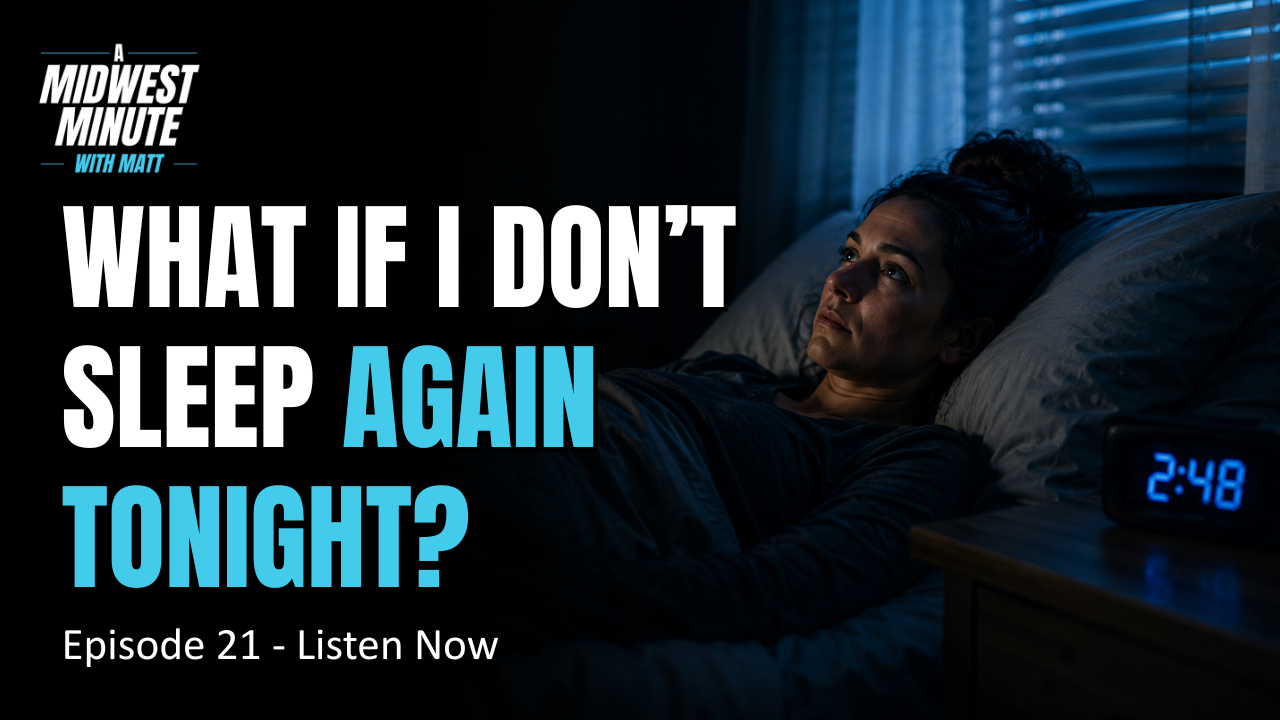
This topic is the focus of Episode 21 of A Midwest Minute with Matt:
“What If I Don’t Sleep Again Tonight?”
If you’ve found yourself lying in bed worrying about whether you’re going to sleep, carrying last night’s poor sleep into tonight, or wondering whether another bad night means your concussion recovery is going backwards, I encourage you to listen.
Listen to the most recent episode at mwconcussion.com/podcast or on your favorite podcast platform.
Midwest Concussion Clinic — Making the Invisible Visible.
This content is for educational and informational purposes only and is not medical advice or a substitute for individualized evaluation or treatment from a qualified healthcare professional.