Driving After A Concussion: When Is It Safe To Drive Again?
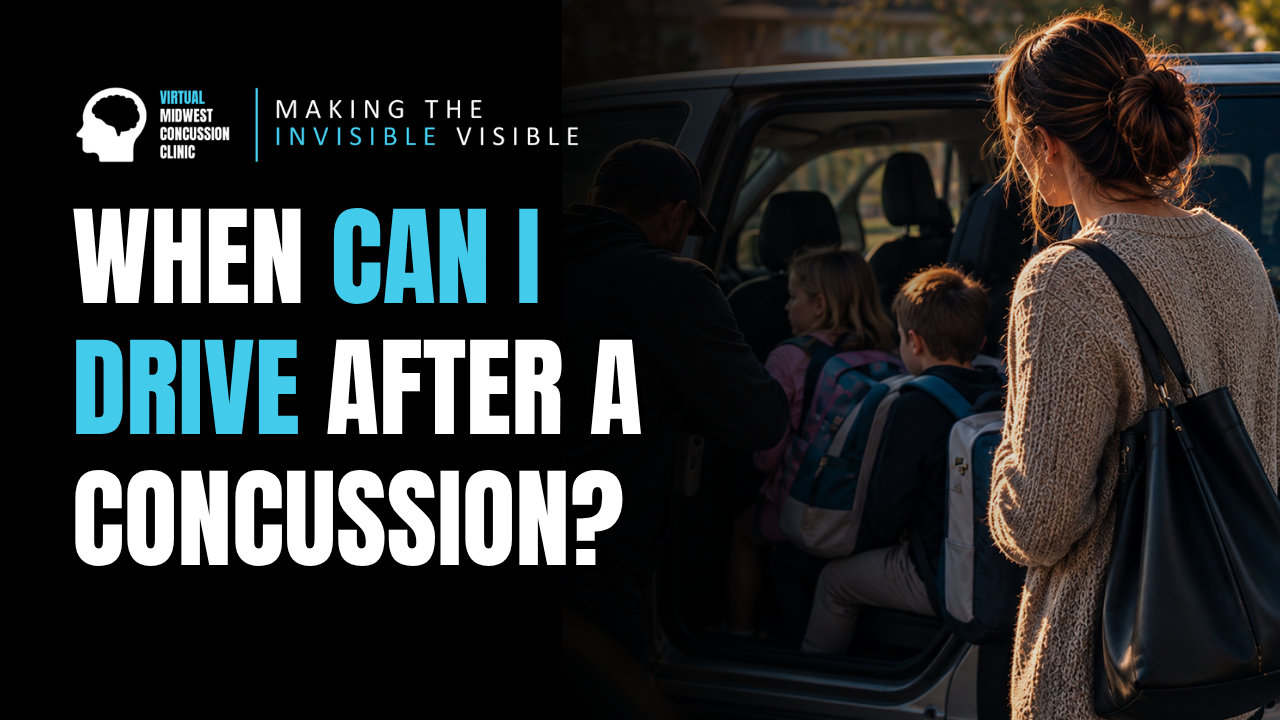
Driving after a concussion isn’t just about how you feel. It’s about how your brain responds to everything driving demands.
One of the most common questions I hear from patients recovering from a concussion is:
“When can I drive again?”
And I understand why.
Driving is more than transportation. It’s independence. It’s getting to work, taking your kids to school, running errands, and being able to do the things you normally do without relying on someone else.
When a concussion takes that independence away, even temporarily, it can be incredibly frustrating.
Unfortunately, there isn’t a universal answer that says everyone can safely drive again after a certain number of days.
That’s because returning to driving isn’t just about time. It’s about function.
To understand when someone may be ready to drive again, we first need to understand what driving actually requires.
Driving Isn’t Just One Task
Think about everything happening when you’re behind the wheel.
You’re watching the road, monitoring your speed, checking your mirrors, following directions, and paying attention to the vehicles around you.
You’re also processing information, making decisions, and responding to changes in your environment.
And you’re doing all of that simultaneously.
Driving requires several systems to work together:
- Vision: Tracking moving objects, shifting your focus, and scanning your surroundings.
- Attention: Maintaining concentration while filtering out distractions.
- Processing speed: Recognizing information and understanding what it means.
- Reaction time: Responding appropriately when something unexpected happens.
- Balance and vestibular function: Tolerating movement, head turns, and changing visual environments.
- Cognitive endurance: Maintaining those abilities throughout the drive.
Now think about the symptoms people commonly experience after a concussion.
Headaches. Dizziness. Blurred vision. Mental fogginess. Difficulty concentrating. Sensitivity to light and movement.
Driving can place demands on many of the same systems that are already struggling during recovery.
In some ways, driving can become a combination of nearly everything that makes concussion recovery challenging.
That’s why feeling better while sitting at home doesn’t automatically mean someone is ready to get behind the wheel.
Three Symptoms That Deserve Special Attention
Although everyone’s recovery is different, there are three symptoms I pay particularly close attention to when discussing driving.
1. Dizziness
Driving involves constant visual movement.
Cars pass beside you. Objects move through your peripheral vision. Your head turns to check intersections, mirrors, and blind spots.
For someone experiencing dizziness or visual motion sensitivity, those demands may become overwhelming.
More importantly, dizziness can interfere with your ability to remain oriented and respond appropriately to your surroundings.
2. Mental Fogginess
Have you ever had a moment where you knew what someone was saying, but it took a little longer to process it?
That’s one way patients sometimes describe mental fogginess.
During everyday activities, a delayed response might simply be frustrating.
Behind the wheel, even a small delay in recognizing and responding to something unexpected can become a safety concern.
3. Blurred Vision
Driving requires clear, coordinated vision.
You need to shift your focus between the road, dashboard, mirrors, signs, and other vehicles.
If your vision becomes blurry, especially with sustained activity or head movement, your ability to gather and interpret important information may be affected.
Dizziness, mental fogginess, and blurred vision are not symptoms I recommend trying to push through while driving.
If these symptoms are present, driving should be postponed until you’ve been appropriately evaluated and your ability to drive safely has been addressed.
Feeling Better Doesn’t Always Mean You’re Ready to Drive
One of the biggest challenges with concussion recovery is that how you feel can change depending on what you’re doing.
You may feel great sitting in a quiet room.
You might tolerate a conversation without difficulty.
You may even feel relatively normal throughout part of your day.
But none of those situations places the same demands on your brain as driving.
The question isn’t simply:
“Do I feel better?”
It’s also:
“Can I safely manage the demands of driving?”
That distinction matters.
Someone may have minimal symptoms at rest but still struggle with visual tracking, divided attention, reaction time, or movement sensitivity.
This is why decisions about returning to driving should consider functional abilities and clinical assessment, not just symptom severity or the number of days since the injury.
Think About Learning to Drive at 16 Again
When discussing the progression back toward driving, I often encourage patients to think about what it was like when they first learned to drive.
You didn’t start on a busy interstate during rush hour.
You started somewhere simple.
You became comfortable with the basics before gradually introducing more demanding situations.
That same general philosophy can help us understand a gradual return after a concussion.
Once a qualified healthcare professional determines that progressing toward driving is appropriate, the process may involve:
Step 1: Riding as a passenger
Before operating a vehicle, consider how you tolerate being in one.
Does the movement make you dizzy? Do passing cars or changing scenery increase symptoms? Can you tolerate the visual environment?
Passenger tolerance can provide useful information, although it does not establish driving readiness.
Step 2: A controlled parking-lot environment
When clinically appropriate and legally permitted, supervised practice in a safe, controlled environment may allow basic driving demands to be assessed.
Step 3: Quiet, familiar roads
A familiar road with limited traffic reduces some of the environmental complexity.
Step 4: Short, familiar trips
As abilities and tolerance improve, duration becomes another consideration.
Step 5: More complex driving environments
Busy intersections, multiple lanes, unfamiliar roads, and heavier traffic introduce additional demands.
Step 6: Normal driving activities
The goal is eventually to return to the driving activities necessary for everyday life, provided safe driving ability has been established.
This is a framework for understanding progression, not a self-clearance checklist or a standardized driving test. The sequence and timing must be individualized, and some people may need formal driving evaluation or rehabilitation.
The goal isn’t to see how much discomfort you can tolerate.
The goal is to return to driving safely and confidently.
You Drove Yesterday. Why Is Today Different?
Another important part of concussion recovery is understanding that driving conditions are not always the same.
Consider these comparisons.
Daytime vs. Nighttime
During the day, visibility may be relatively consistent.
At night, headlights, glare, reduced visibility, and changing contrast create different visual demands.Country Roads vs. Interstates
A quiet country road and a busy interstate require different levels of attention, visual processing, and decision-making.
Clear Weather vs. Rain
Rain introduces additional movement, reflections, reduced visibility, and unpredictable driving conditions.
Add headlights and heavy traffic, and the demands increase even further.
The important point is that one successful drive does not automatically mean you’re ready for every driving environment.
Your ability to manage a short, familiar trip in ideal conditions doesn’t necessarily establish your ability to manage a longer drive at night in heavy traffic.
The environment matters.
Sometimes the Drive Home Isn’t the Real Problem
Here’s another situation I frequently discuss with patients.
You drive to work in the morning and feel fine.
You make it through the workday.
But when it’s time to drive home, everything feels more difficult.
Why?
Because the drive home isn’t happening in isolation.
Think about everything your brain has already done throughout the day.
You’ve participated in conversations, looked at screens, processed information, made decisions, managed distractions, and responded to your environment.
Each activity requires effort.
And for someone recovering from a concussion, those demands may accumulate.
By the time you’re ready to drive home, your ability to tolerate additional cognitive and visual demands may be different than it was that morning.
This is why I encourage patients to look beyond the activity itself and consider everything that happened before it.
The drive home may not be the only problem.
It may be the additional demand placed on a system that’s already been working hard all day.
That doesn’t mean every difficult drive is caused by accumulated demand, and fatigue should never be treated as something to drive through. It means the entire day deserves consideration when evaluating readiness.
“I Just Want My Independence Back.”
This is the part of the conversation that matters just as much as the clinical details.
When someone tells me they want to drive again, they’re often telling me something bigger.
They want their routine back.
They want to stop depending on other people.
They want to feel like themselves again.
And those feelings deserve to be acknowledged.
Concussion recovery can affect far more than symptoms. It can affect someone’s confidence, relationships, responsibilities, and sense of independence.
That’s why returning to driving should never be treated as just another box to check.
It’s an important milestone.
But returning too soon and placing yourself or others at risk isn’t the independence we’re working toward.
The goal isn’t simply getting back behind the wheel. It’s getting back behind the wheel safely.
So, When Can You Drive After a Concussion?
There isn’t a single number of days that applies to everyone.
If you’re experiencing dizziness, blurred vision, mental fogginess, slowed reactions, or other symptoms that could interfere with driving, you should not drive.
You should also avoid driving while taking medications that impair alertness or reaction time.
The decision to resume driving should be made with an appropriately qualified healthcare professional, taking into account your symptoms, vision, vestibular function, attention, processing speed, reaction time, and the actual demands of driving. More complex cases may require a formal driving assessment.
A person can feel better without necessarily being ready for every activity.
And a person can make meaningful progress without being fully recovered.
Those two things can be true at the same time.
At the Midwest Concussion Clinic, we focus on understanding the challenges someone is experiencing, identifying what may be contributing to those challenges, and helping them build toward the activities that matter most.
Because recovery isn’t simply about reducing symptoms.
It’s about helping people return to their lives.
And sometimes, that means helping someone work toward the confidence and independence that comes with getting behind the wheel again.
Life doesn’t stop after a concussion. And recovery should be about helping you get back to living it.
Listen to the Conversation
Want to explore this topic further?
In Episode 25 of A Midwest Minute With Matt, “When Can I Drive After a Concussion?”, we discuss why driving can be so challenging after a concussion, what to consider before returning, and why independence is such an important part of recovery.
Listen at mwconcussion.com/podcast.
About Midwest Concussion Clinic
Midwest Concussion Clinic provides individualized, fully virtual concussion care for patients of all ages, including concussion evaluations, rehabilitation, and ongoing recovery guidance.
Our philosophy is simple: Better care begins with understanding.
Learn more at mwconcussion.com.
This article is intended for educational purposes and does not replace individualized medical advice or a formal assessment of driving fitness. Driving restrictions and clearance requirements may vary based on the individual, applicable law, and the healthcare professionals involved.